
Caste-Based Disparities in Economic Development: Analyzing Income, Education, and Employment Inequalities in India


Caste-Based Disparities in Economic Development: Analyzing Income, Education, and Employment Inequalities in India
~ Shireen Banerjee
Introduction
The caste system in India, an ancient hierarchical social structure, has perpetuated social inequalities for centuries. Despite legal measures and social reforms, caste-based disparities persist, impacting the distribution of income, access to education, and employment opportunities. This paper aims to provide an in-depth analysis of these disparities and their implications for economic development. Caste-based disparities in India have persisted despite economic development, and these disparities are evident in income, education, and employment opportunities. The influence of caste extends beyond private economic activity into the public sphere, where caste politics determine access to public resources. Dominant land-owning agricultural castes hold key positions in society using their economic, political, and social capital. The aggregate evidence indicates that there has been convergence in education, occupations, income, and access to public resources across caste groups in the decades after independence. However, caste networks may still be salient in India, and it is important to understand the positive and negative consequences of caste involvement across a variety of spheres in the Indian economy.
During the COVID-19 pandemic, members of lower castes suffered heavier job losses due to their higher representation in precarious daily wage jobs and their lower levels of education4. Lower caste families are less able to help their children with remote learning, which threatens to worsen labor market inequality in India. The objective is to develop entrepreneurial activities as a means of circumventing labor market discrimination, fostering "Dalit capitalism". Caste-based inequalities are not simply limited to inequality in opportunity.
Historical Context
The caste system originated as a means of social division and labor specialization. The four main castes (Brahmins, Kshatriyas, Vaishyas, and Shudras) were supplemented by numerous sub-castes (jatis), with Dalits (formerly known as Untouchables) at the bottom. This system assigned individuals to specific roles and professions based on birth. The influence of caste extends beyond private economic activity into the public sphere, where caste politics determine access to public resources. Although the Indian government has officially outlawed caste discrimination and made widespread reforms, the caste system still plays a role in Indian society today.
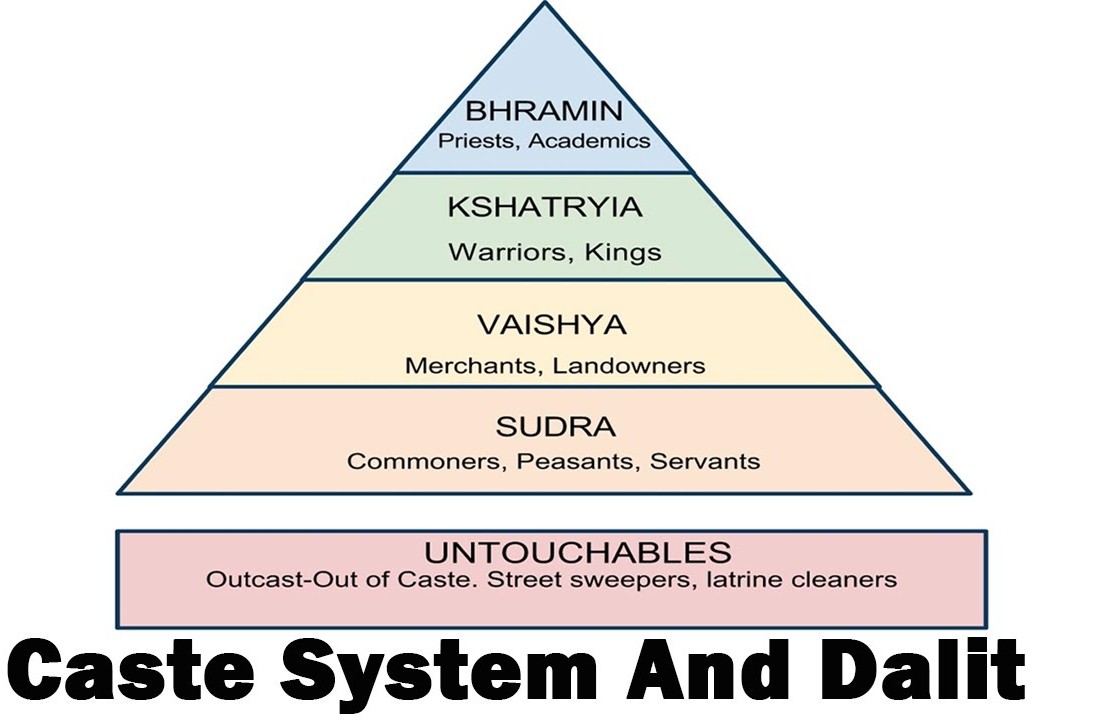
Source: https://muktipadablog.wordpress.com/2015/12/10/origin-of-indian-caste-system/
Income Disparities
Caste-based income disparities are evident across India. Studies show that historically marginalized castes, particularly Dalits and certain Adivasi groups, often face lower wages, limited access to resources, and exclusion from economic opportunities. Discrimination in the job market and limited access to land ownership contribute to income inequality. According to the National Family Health Survey (NFHS-4) conducted in 2015-16, the average monthly per capita expenditure of households from SCs and STs was lower than that of households from general castes. SC and ST households also had a higher percentage of people living below the poverty line.
Education Disparities
Access to quality education remains a challenge for lower-caste communities. Discrimination, social stigmatization, and economic barriers hinder educational attainment for Dalits and Adivasis. As education is a key driver of economic mobility, these disparities perpetuate cycles of poverty. Data from the National Sample Survey Office (NSSO) revealed that while there has been an increase in educational attainment among marginalized groups, there remains a considerable gap. In 2017-18, the literacy rate for Scheduled Castes (SCs) was around 70%, significantly lower than the overall national literacy rate of around 77%. Similarly, Scheduled Tribes (STs) had a literacy rate of around 58%.
Employment Disparities
Caste-based discrimination extends to the employment sector, affecting job opportunities and career advancement. Many individuals from marginalized castes are relegated to low-paying and menial jobs, while upper-caste individuals dominate higher-skilled professions. This hampers overall economic productivity and growth. The Annual Employment-Unemployment Survey by the Ministry of Labour and Employment indicated that SCs, STs, and OBCs were more likely to be engaged in low-paying and manual jobs, compared to individuals from upper castes. The majority of these jobs lack social security benefits and job stability.
Causes of Caste-Based Disparities
The persistence of caste-based disparities can be attributed to a complex interplay of historical, social, economic, and cultural factors. Traditional attitudes, prejudices, and the perpetuation of the caste mindset through intergenerational socialization contribute to the continuation of these disparities. The causes of caste-based disparities in India are complex and multifaceted. Caste plays a role at every stage of an Indian's economic life, and the influence of caste extends beyond private economic activity into the public sphere. Although there has been convergence in education, occupations, income, and access to public resources across caste groups in the decades after independence, there is still a notable earning inequality between SC, ST, and OBC and the rest of the population. The COVID-19 pandemic has also highlighted the disproportionate impact on lower castes. Additionally, the groups in India that are generally considered disadvantaged have substantially lower wealth than the “forward” caste groups, and between-caste inequality accounts for a significant portion of overall wealth inequality.
Implications for Economic Development
Caste-based disparities impede India's economic development in several ways. By excluding a significant portion of the population from equal participation in the economy, the country fails to harness its full productive potential. The lack of inclusivity also leads to social unrest, creating an environment that is not conducive to sustainable development. Addressing these disparities is vital for leveraging India's diverse talents, fostering innovation, and achieving inclusive economic growth.
Policy Interventions
The Indian government has implemented a range of policies to address caste-related issues and promote social equity. These policies include affirmative action through reservations in education and jobs for Scheduled Castes (SCs), Scheduled Tribes (STs), and Other Backward Classes (OBCs). The Scheduled Castes and Scheduled Tribes (Prevention of Atrocities) Act criminalizes discrimination and violence against these groups. Schemes like the National Rural Employment Guarantee Act (NREGA) provide employment opportunities, and scholarship programs aim to improve education access. Development plans, commissions, and dedicated budget allocations like the Special Component Plan (SCP) and Tribal Sub-Plan (TSP) work to uplift marginalized communities. Additionally, initiatives for entrepreneurship and rural development further address disparities, though challenges in implementation and attitude change remain.
Conclusion
The enduring caste system in India perpetuates disparities in income, education, and employment. Despite legal actions and social changes, these inequalities persist, hampering economic development. Marginalized groups face lower wages, restricted education access, and limited job opportunities due to discrimination. These disparities result from complex historical and cultural factors, affecting both private and public realms.
These inequalities hinder India's economic potential by excluding a significant part of the population, causing lower productivity and social unrest. Government policies, like reservations and anti-discrimination laws, aim to address these challenges. However, effective implementation remains a hurdle. To realize inclusive growth, it's essential to tackle these disparities, unlocking India's diverse talents for sustained economic progress.
By dismantling the structural barriers that perpetuate caste-based inequalities, India can pave the way for more inclusive and sustainable economic growth.
References:
https://www.aeaweb.org/articles?id=10.1257%2Fjel.20171307
https://www.economicsreview.org/post/caste-and-the-indian-economy
https://www.ncbi.nlm.nih.gov/pmc/articles/PMC3379882/
https://muktipadablog.wordpress.com/2015/12/10/origin-of-indian-caste-system/
https://theconversation.com/the-multiple-faces-of-inequality-in-india-182074
https://www.levyinstitute.org/publications/caste-and-wealth-inequality-in-india
https://papers.ssrn.com/sol3/papers.cfm?abstract_id=3847031
Comments
Post a Comment